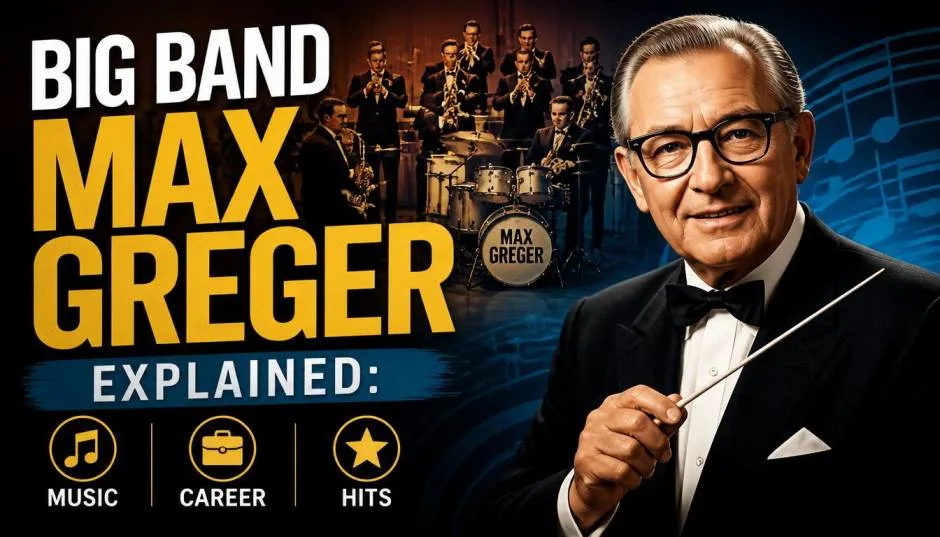
Max Greger was the man who brought world-class big band sound to German television. For millions of viewers, his orchestra was the sound of Saturday night entertainment. But his story goes much deeper than that.
He started as a saxophonist playing in American clubs, built a band that Count Basie called the best in Europe, and toured the Soviet Union when few Western musicians dared.
If you are searching for big band max Greger, this guide covers his career, his hits, and what made his music special.
From Butcher's Son to Swing Legend
Max Greger was born in Munich on April 2, 1926, the son of a butcher. Music came early. He received an accordion as a child and later studied piano, clarinet, and saxophone at the Munich Conservatory.
Read Also: When I Hear Music Piano Notes Sheet Music?
After World War II, Greger started playing in dance bands at American officers' clubs. The jazz influence was strong. He worked with trumpeter Charly Tabor, playing accordion, then clarinet, then tenor saxophone.
The breakthrough years:
-
1948: Formed his first sextet. Hugo Strasser was among the musicians
-
1955: Expanded to a 13-piece band playing Glenn Miller-style arrangements
-
1959: First Western orchestra to tour the Soviet Union—36 sold-out concerts
The Soviet tour was a defining moment. Greger's band performed 36 concerts across the USSR, bringing Western swing to audiences who had never heard it live.
The ZDF Years: Television Stardom
1963 changed everything. Greger was offered the position of Musical Director for Germany's second television channel, ZDF. This was the dream job for any bandleader. He built a 16-piece orchestra that performed on television for over 16 years.
What the ZDF orchestra did:
-
Played for plays, series, musicals, and hit parade shows
-
Recorded interval music—everything from twist to schmaltz to jazz
-
Became the house band for major TV entertainment shows
Greger was a perfectionist. No tape left the studio with mistakes, musical or technical. The band recorded in Munich's best studio. Engineer Willi Schmidt built custom equipment and recorded everything in stereo—cutting-edge for the time.
Count Basie's verdict: After hearing the Greger orchestra, Count Basie called them the best European band he had ever heard.
The Band: Europe's Finest
Greger handpicked his musicians. He wanted the best band in Europe. The brass section alone had eight players.
You Must Also Like: The Best Routine to Get Better at Playing Guitar 2026
International line-up:
-
Ron Simmonds (Britain): Lead trumpet, played top Gs for 24 bars straight
-
Benny Bailey (USA): Featured jazz trumpeter, worked with Lionel Hampton and Dizzy Gillespie
-
Don Menza (USA): Saxophonist, played with Stan Kenton and Maynard Ferguson
-
Dick Spencer (USA): Lead alto, just finished military service in Germany
-
Pierre Favre (Switzerland): Drummer, spoke French, German, and English
-
Branko Pejakovic (Yugoslavia): Bassist, spoke eight languages
The band was tremendously versatile. They played jazz, pop, polka, and Schlager. They recorded printed arrangements by Ernie Wilkins, Marshall Brown, and Billy May. But Greger also encouraged original compositions from within the band.
Max Greger Sail Along Silvery Moon
One of Greger's most enduring recordings is "Sail Along Silvery Moon." The track was composed by Percy Wenrich . Greger's version runs just over two minutes long.
Where to find it:
-
Appears on the album Silberfäden
-
Also included in compilation albums: Eine Reise in's Glück, Happy Birthday - 80 Jahre - 40 Hits, and Das Beste
-
Available on Spotify, Deezer, and other streaming platforms
Max Greger Silberfäden is a notable album in his catalog. The title translates to "Silver Threads." It features easy-listening arrangements that showcase Greger's melodic style.
His Most Famous Number: 23 Seconds of Fame
Greger was proud of one piece more than any other. The theme music he wrote for ZDF's sports program "Aktuelles Sportstudio".
It runs just 23 seconds. But for millions of German viewers, those 23 seconds were instantly recognizable.
Musical Style: More Than Just Jazz
Greger recorded over 150 records—jazz and pop . His style drew heavily from Glenn Miller . But he refused to be boxed in.
What he played:
-
Swing: The Miller influence was always present
-
Jazz: Recordings like European Jazz Sounds (1963) and Maximum (1965)
-
Pop: Easy-listening arrangements for television
-
Polka and Schlager: Whatever German audiences wanted
His saxophone sound: Greger played tenor sax in the "blow hard and blow 'em away" school . His tone was powerful, direct, and unmistakable. One critic described him as "an Earl Bostic/Tiny Bradshaw/Arnett Cobb–style tenor saxophonist".
The Legacy Continues
Max Greger died on August 15, 2015, at age 89 . He had given his last concert in Munich in mid-July. Two days later, he was hospitalized with cancer. His wife said he had "a wonderful old age".
The musical legacy continues through his family. His son, Max Greger Jr., and grandson, Max Greger III, are both musicians.
Later years: Greger toured with Paul Kuhn and Hugo Strasser as part of the "Swing-Legenden" (swing legends). These concerts in Germany were well received. Three old masters, still swinging.
What Made Greger's Music Special?
Greger built an international orchestra in a country that had no big-band tradition. He hired the best players from America, Britain, and across Europe. He gave them the budget, the time, and the freedom to create.
The ZDF advantages:
-
Three hours could be spent on one title
-
Musicians could play what they wanted for interval music—mostly jazz
-
Greger wrote charts himself and commissioned from arrangers within the band
The band had no weaknesses. As Ron Simmonds put it, they "hadn't yet found anything that it couldn't tackle".
Where to Start Listening?
| Album | Year | What to Expect |
|---|---|---|
| Swingtime (with RIAS Big Band) | 1999 | Swing classics with Benny Bailey |
| European Jazz Sounds | 1963 | Early jazz recording |
| Maximum | 1965 | Pop and jazz mix |
| Silberfäden | Various | Easy listening, includes "Sail Along Silvery Moon" |
The Final Thoughts
Max Greger was more than a bandleader. He was a musical pioneer. He brought world-class big band music to German television, recorded over 150 albums, and created a sound that defined an era.
His "Sail Along Silvery Moon" remains a charming artifact of his easy-listening work. But his true legacy is the swing. The ZDF television theme. The Soviet tour. The band that Count Basie called Europe's best.
Max Greger's music swings. That is what matters most.