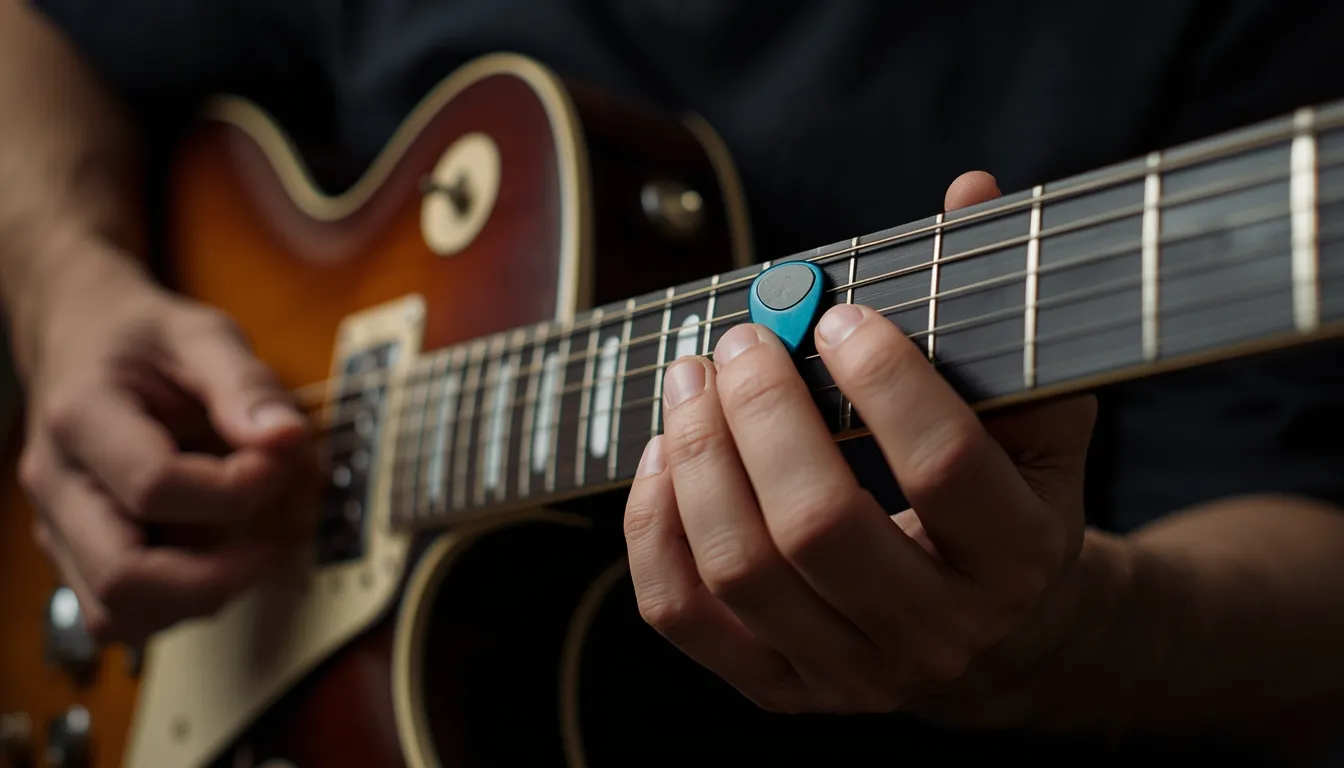
So, you’ve got a lovely acoustic guitar. You’ve tuned it up, learned a few chords, and you’re prepared to make a few music. But something feels off. The sound is a small lean, or perhaps it’s catching on the strings. Before you fault the guitar, see at your hand. Particularly, see at how to hold a guitar pick.
I keep in mind when I to begin with begun. I grasped that small triangle of plastic like it was a winning lottery ticket. My knuckles were white, my wrist was bolted, and the tone?
It sounded like I was assaulting the strings with a butter cut. It wasn't until a friend—a much way better player—adjusted my grasp that the guitar really begun to sing.
Holding a choose accurately is the single speediest way to make strides your tone. It is the bridge between your vitality and the instrument. A awful hold muffles your sound. A great hold opens clarity, warmth, and control.
This isn't almost holding on. It is approximately making a association. We'll clarify how to do it and why it works. At that point, since tone comes from both your hand and your instrument, we'll investigate the best guitar picks for acoustics to coordinate your unused technique.
Why Your Grip Dictates Your Tone?

Before we get into the "how," let's conversation about the "why." Numerous apprentices think a choose is a way to strum. In reality, it's a little lever that exchanges the vitality of your hand to the strings.
Read Also: How to Make DIY Guitar: A Step-by-Step Guide for Beginners
If you hold the choose as well firmly, you choke it. The choose can't vibrate, and that vitality gets caught in your hand. The result is a cruel, "thumpy" assault with no reverberation.
If you hold it as well freely, you lose control. The choose moves around, gets caught on strings, and you conclusion up with a powerless, conflicting sound. The objective is a "firm but loose" grasp.
Think of it as holding a little winged creature. You need to hold it safely so it doesn't fly absent, but delicately sufficient that you do not harmed it. Your choose needs that same respect.
The Step-by-Step Guide to the Perfect Pick Grip
Let's walk through this. Snatch your choose and your acoustic guitar. We're building muscle memory today.
1. Begin with Your Hand
Shake your hand out. Let it go limp. Feel how free your wrist is? That’s the feeling we need to protect. Presently, bring your hand up like you are around to delicately thump on a door.
2. Shape the Foundation
Make an "Alright" sign with your thumb and list finger. See at the circle you made. Presently, take your choose and put it on the cushion of your list finger. The choose ought to sit right on the side of your finger, covering the fingerprint.
3. The Thumb Closure
Bring your thumb down directly on best of the choose. Your thumb should be adjusted with your record finger, shaping a rotate point. The choose tip should point specifically toward your sternum (or toward the headstock of the guitar).
4. The Golden Rule of Exposure
Here is where most people go wrong. Look at how much of the pick is sticking out from your fingers.
-
Too much: If half the pick is showing, it will act like a long lever. It will be floppy, uncontrollable, and get caught in the strings.
-
Too little: If you are gripping right at the tip, you’ll have no flexibility. Your tone will sound stiff and dead.
The Sweet Spot: As it were let the tip of the choose adhere out. Approximately a quarter to a third of the choose should be uncovered. This gives you the culminate adjust of control and flexibility.
5. The 45-Degree Secret
Now, put your hand on the guitar. Do not hold the choose level and parallel to the strings. If you do, it will capture and drag with a boisterous thud each time you hit the string.
Instead, point the choose somewhat. Rotate it about 45 degrees so the edge hits the string to begin with, not the level side. This makes less resistance.
The choose floats through the string, creating a smoother, clearer tone. This is in some cases called "riding the bevel."
6. Grapple Lightly
Rest the side of your palm (the meaty portion underneath your pinky) gently on the bridge of the guitar. This is your grapple. It stabilizes your hand. For strumming, you will utilize more of your wrist.

For single-note picking, you will utilize a combination of wrist and fingers. But the grapple stays.
Common Botches That Murder Your Acoustic Sound
Even with the steps over, awful propensities crawl in. Here are three things I see all the time—and how to settle them.
You Must Also Like: Top 5 Best Electric Guitars for Kids 2025
-
The White-Knuckle Hold: If your hand turns white, you are crushing as well difficult. This makes pressure that voyages all the way up your arm. It will weakness you rapidly and make your tone sound brittle.
-
Fix: Hone playing with the mildest touch conceivable. Center on the feel of the choose in your hand. Remind yourself each few minutes to "relax."
-
The Crab Claw: Now and then, guitarists splay their other fingers out solidly. It looks awkward since it is. That pressure in your fingers spreads to your wrist.
-
Fix: Twist your other fingers freely into your palm. It makes a more loose, common shape for your hand.
-
Too Numerous Picks: Are you holding the choose way down at the wide conclusion? You're losing all your leverage.
-
Fix: Alter your grasp so you are holding it closer to the pointed conclusion. You’ll right away feel more control.
Matching the Pick to Your Grip: The Best Guitar Picks for Acoustics
Now that your hand knows what to do, let's conversation almost the instrument. You can have culminate method, but if you are utilizing the off-base choose, your acoustic will never sound its best.
The best guitar picks for acoustic guitar are not the same as the best picks for electric guitar. Acoustic guitars depend on the vibration of the wood to venture sound.
You require a choose that helps that happen, not one that battles it. Here is a simple rule of thumb:
-
Thin picks (.40mm – .60mm): Great for strumming. They are flexible and produce a bright, "swishy" sound. Perfect for folky rhythm playing.
-
Medium picks (.60mm – .80mm): The Goldilocks zone for many acoustic players. They are flexible enough for strumming but stiff enough for picking out melodies.
-
Heavy picks (.80mm+): These provide a fat, warm, and articulate tone. They're great for soloing and flatpicking, like in bluegrass. But, if you're not careful, they can sound too "thumpy" for gentle strumming.
My Personal Recommendations (From Real-World Use)
I have a drawer full of picks. A few are awesome, a few are tidy collectors. If you want to buy guitar picks, check out music shops or online stores like Sweetwater and Guitar Center.
They have a colossal choice. But to spare you the trial and mistake, here are the ones I keep coming back to.
1. Best: Dunlop Tortex Standard .73 mm (the "yellow" one)
This is the gold standard for a reason. The Tortex fabric has a matte wrap up. It offers awesome grasp, indeed if your fingers sweat.
It is strong; it doesn't wear down rapidly, and the .73mm gage hits that culminate sweet spot for acoustic. It is firm sufficient for exact interchange picking but flexes sufficient for enormous, open strumming.
-
Pros: Great grip, durable, versatile tone (bright and articulate).
-
Cons: The matte feel isn't for everyone; some prefer a slicker surface.
2. Best for Strumming: Fender Premium Celluloid .45 mm (thin)
This is the classic choose. It’s the one you picture when you think of a guitar choose. I adore these for campfire melodies and enormous, washing-machine strumming.
The .45mm celluloid is lean and floppy, which makes that classic "shaker" sound on the strum. It’s shinning and percussive.
-
Pros: Classic warm tone, lightweight, and comfortable.
-
Cons: They wear down fast (celluloid is soft), and they can slip if your hands are dry or wet.
3. Best for Grip & Control: Dunlop Max-Grip .71 MM
If you battle with the choose turning around in your fingers, this is your arrangement. The Dunlop Max-Grip line has a rubberized, finished surface that feels nearly shabby.
It sticks to your fingers like glue. The .71mm nylon center gives a warm, adjusted tone that sits pleasantly in an acoustic blend.
-
Pros: Virtually impossible to drop, warm tone, controlled feel.
-
Cons: The grip texture can create a little friction on the fingers, which takes a minute to get used to.
4. Best for Lead & Flatpicking: Ernie Ball Prodigy 1.5 mm or 2.0 MM
These are little, sharp, and fantastically exact. Producers utilize Delrin to make them. They include a beveled edge, which makes a difference them coast over the strings with no resistance.
For quick, complex flatpicking leads, like Doc Watson's fashion, this choose is idealize. It produces a fat, centered tone that cuts through.
-
Pros: Unbelievable precision, durability, fast.
-
Cons: Too stiff for strumming chords; it can sound harsh. Not for beginners.
5. Best Budget / Variety Pack: Gibson Standard-Style Picks
Sometimes you don't know what you like until you try it. A pack of Gibson Standard Style picks is a great way to start. They are classic celluloid, medium gauge, and comfortable. They are lightweight and give you that "old school" feel.
-
Pros: Affordable, classic feel, great value.
-
Cons: They are a basic pick—no special grip, no advanced bevels.
Quick Comparison: Best Guitar Picks for Acoustic
| Pick Model | Material | Gauge (Thickness) | Best For | Tone |
|---|---|---|---|---|
| Dunlop Tortex .73 | Tortex | Medium | All-around playing | Bright & Articulate |
| Fender Celluloid .45 | Celluloid | Thin | Strumming | Warm & Bright |
| Dunlop Max-Grip .71 | Nylon/Rubber | Medium | Players with sweaty hands | Warm & Rounded |
| Ernie Ball Prodigy | Delrin | Heavy (1.5+) | Lead / Flatpicking | Fat & Focused |
| Gibson Standard | Celluloid | Medium | Beginners / Value | Classic |
How to Practice Your New Grip?
Holding a pick and feeling comfortable with it is not the same. You have to build the muscle memory.
-
The Silent Practice: While watching TV, hold your pick. Practice the grip. Roll it between your fingers. Get used to the feel.
-
The One-String Exercise: Pick one string. Play it slowly, over and over, with perfect downstrokes. Focus on the angle of the pick. Listen to the tone. Is it clean? Then do upstrokes.
-
The Metronome Test: Set a metronome to a slow speed (70 BPM). Strum a G chord. Strum exactly on the click. Focus on a relaxed wrist. If you feel tension, slow down.
The Final Thoughts
Your tone begins in your hands, not in the guitar. By acing how to hold a guitar pick, you open the true voice of your instrument. You move from battling the strings to moving with them.
Experiment with the picks I specified. Buy a few distinctive ones another time you are at the store. Attempt the lean Bumper for strumming. Attempt the Dunlop Tortex for everything else. Feel how the fabric and thickness alter the sound.
And keep in mind: keep it loose. Keep it calculated. And let the tip do the work. Upbeat playing.