So, you finally got your guitar to begin with. It was a birthday display, or you at last gave in to that tingle to learn. You open your case, strum a string, and it sounds like a solo note. You need to play a song.
I keep in mind sitting in my bedroom staring at a chord chart, feeling like my fingers were made of butter. They slipped, they buzzed, and they harmed. But here is the truth: you, as it were, need a handful of chords to open thousands of well-known songs.
What Is the Easy Guitar Chords Songs?

If you are looking for simple guitar chord songs to play for your companions or for fun, you are in the right place. We aren't going to plunge into music theory language.
Read Also: How to Tune a Guitar With a Guitar Tuner?
We are going to see the actual finger placements that work for real beginners. Here are the 8 basic guitar chords you must know, how to put your fingers, and the tunes that show you can sound great today.
1. The Em Chord (The Most Effortless of Them All)
Let’s begin with a win. The E minor chord is the best companion for each tenderfoot. It requires, as it were, two fingers, and it sounds touchy and cool.
-
Guitar chords finger placement for beginners: Place your middle finger on the 2nd fret of the A (5th) string. Place your ring finger on the 2nd fret of the D (4th) string. Strum all six strings.
-
Why it works: There are no tricky stretches. You can go from an open strum to this shape instantly.
-
Real Song Use: "Wish You Were Here" by Pink Floyd. Strum that chord slowly, and you’ve already nailed the intro vibe.
2. The G Chord (The Stretch)
Ah, the G chord. This one frustrated me for a week. It requires your fingers to leave their comfort zone.
-
The Placement: Place your middle finger on the 2nd fret of the low E (6th) string. Ring finger on the 3rd fret of the B (2nd) string. Pinky on the 3rd fret of the high E (1st) string. (Some people use fingers 2, 3, and 4 for this).
-
The Struggle: You might mute the A string. That’s normal.
-
Pro Tip: If the full G is too hard right now, play "G6" by leaving your ring finger off and just playing the open strings with the middle finger on the bass. It’s a cheat code until your stretch improves.
3. The C Chord (The Shift)
The C major chord is where you learn that your fingers have to learn to stand up straight. If your fingers touch the off-base strings, you get a "crash" instep of a ring.
-
Guitar chord finger placement pictures in books always look perfect. In reality, you need to curl your fingers like you're holding a small apple.
-
The Placement: Ring finger on the 3rd fret of the A (5th) string. Middle finger on the 2nd fret of the D (4th) string. Index finger on the 1st fret of the B (2nd) string.
-
Check: Strum from the A string down. If the high E rings out clear, you’re winning.
4. The D Chord (The Triangle)
The D major chord looks like a triangle on the fretboard. It sounds bright and happy.
-
The Placement: Index finger on the 2nd fret of the G (3rd) string. Ring finger on the 3rd fret of the B (2nd) string. Middle finger on the 2nd fret of the high E (1st) string.
-
The Rule: Do not strum the low E or A strings. It will sound awful. Focus your strumming on the bottom four strings.
-
Personal Insight: When I started, I put stickers on the pickguard near the D string to remind myself where to strum. Do whatever helps you remember.
5. The A Chord (The Squish)
The A major chord is a challenge because it requires three fingers crammed into the same fret.
-
The Placement: Index, middle, and ring fingers all lined up on the 2nd fret of the D, G, and B strings (strings 4, 3, and 2).
-
The "Aha!" Moment: You will mute the high E string accidentally. It happens to everyone. Tilt your fingers slightly so they are "on their tiptoes."
-
The Shortcut: Many pros play the A chord as a "barre" shape using one finger across the three strings. Try that if the three-finger method feels too tight.
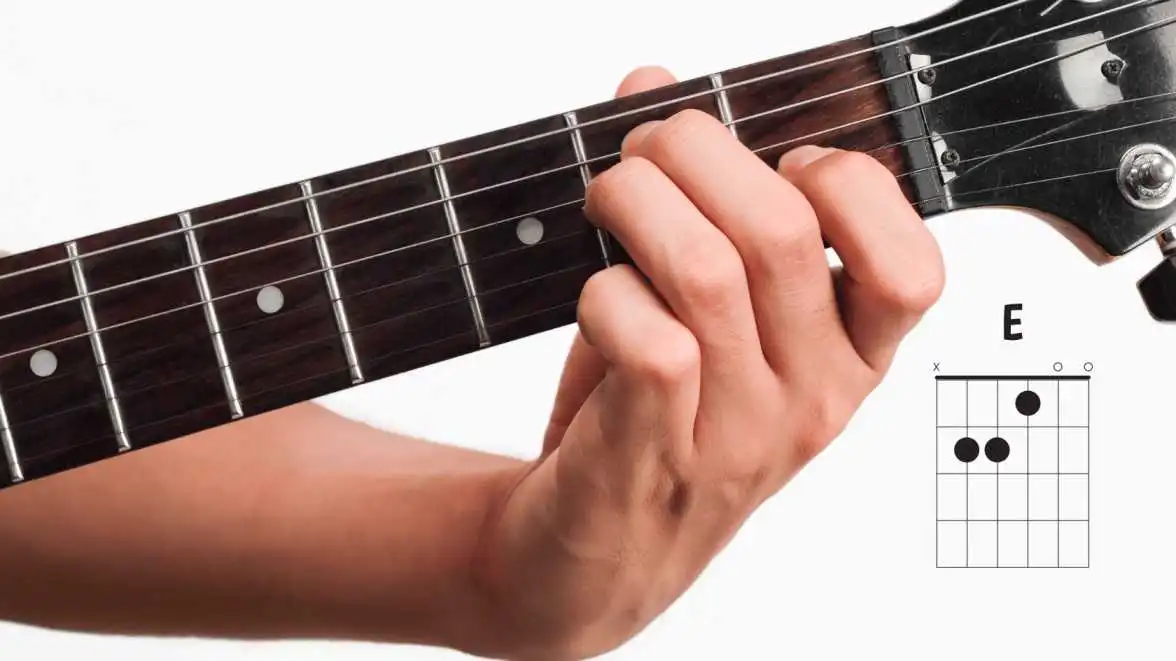
6. The E Chord (The Full Sound)
E major is like the big brother of Em. It fills the room with sound because it uses all six strings.
You Must Also Like: How Long Does It Take to Learn Guitar?
-
The Placement: Index finger on the 1st fret of the G (3rd) string. Middle finger on the 2nd fret of the A (5th) string. Ring finger on the 2nd fret of the D (4th) string.
-
Strumming: Hit everything. It’s impossible to mess up the strumming pattern on this one.
-
Why You Need It: This chord is the backbone of rock and roll. Without it, you can't play the opening riff of "Johnny B. Goode."
7. The Am Chord (The Sad One)
If Em is moody, A minor is straight-up sad movie music. It is also incredibly easy to transition to from other chords.
-
The Placement: Middle finger on the 2nd fret of the D (4th) string. Ring finger on the 2nd fret of the G (3rd) string. Index finger on the 1st fret of the B (2nd) string.
-
The Feel: This chord uses the same shape as E major, but shifted down a set of strings. Notice the pattern?
8. The Dm Chord (The Challenge)
D minor is the hardest on this list for most beginners. It requires a barre with your index finger while the others stretch.
-
The Placement: Index finger barres the 1st fret of the high E and B strings. Middle finger on the 2nd fret of the G string. Ring finger on the 3rd fret of the B string.
-
Don't Panic: If it sounds muted, skip it for a week. Focus on the others, then come back. Your hand strength needs to build.
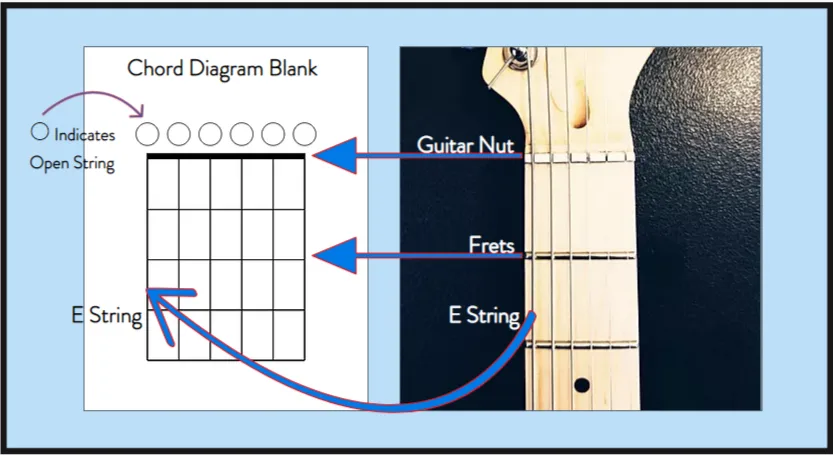
Guitar Chords Finger Placement Chart
To help you visualize, here is a mental map. Think of your strings from floor to ceiling (low E to high E).
-
G Chord: 6th string (2nd fret), 2nd string (3rd fret), 1st string (3rd fret).
-
C Chord: 5th string (3rd fret), 4th string (2nd fret), 2nd string (1st fret).
-
D Chord: 3rd string (2nd fret), 2nd string (3rd fret), 1st string (2nd fret).
-
A Chord: 4th string (2nd fret), 3rd string (2nd fret), 2nd string (2nd fret).
Memory Trick: Keep a sticky note on your desk. Draw the dots. Repetition is how you learn, not staring.
Putting It Together: Easy Guitar Chords Songs

Knowing the chords is step one. Utilizing them is step two. Here is the enchantment: These 8 chords are a toolkit. Here are three tunes you can play right now utilizing as it were the 5 basic guitar chords for beginners we fair secured (G, C, D, Em, Am).
-
"Horse With No Name" by America: This song uses only Em and D6/F#m (a fancy name for a shape you already know). It is two chords for the whole song.
-
"Let It Be" by The Beatles: C, G, Am, F. (Note: The F chord is hard. For now, play F as "Fmaj7"—Move the C shape up one string. Nobody will judge you at the campfire.)
-
"Zombie" by The Cranberries: Em, C, G, D. This uses the guitar chords finger placement for beginners that we practiced. The trick is the strumming pattern (bounce on the offbeat), but the chords are simple.
What Nobody Tells You About Finger Placement?
When I to begin with looked at a guitar chords finger placement chart, I thought my hands were broken. The charts appear to be positioned at a perfect right angle to the neck. My fingers are brief and level. Here is the truth about playing:
-
Fingertips only: You must trim your fingernails on your fretting hand. If your nails click on the fretboard, cut them. You cannot press effectively with nails.
-
The Thumb Position: Don't death-grip the neck with your thumb over the top (yet). Keep your thumb planted firmly on the back of the neck, roughly behind your middle finger. This gives you leverage.
-
Buzz is Normal: If a string buzzes, it means you aren't pressing hard enough, or your finger is too close to the metal fretwire. Move your finger slightly towards the body of the guitar (behind the fret).
Experience vs. Expectation: My Gear Advice
If you are struggling to press down the strings, it might not be your fault. It might be your guitar. When searching for gear to help you learn these easy guitar chords songs, there are two things to watch out for:
The Guitar Itself:
-
Reality: Cheap guitars (under $100) often have "high action." This means the strings are too far from the neck. You have to press down like you're squeezing an orange. It hurts, and it ruins your motivation.
-
Practical Advice: If you have a cheap guitar, take it to a shop for a "setup." It costs about $40-$60. They lower the strings for you. It makes playing the 8 basic chords 80% easier. Do not buy a new guitar; Fix the one you have.
String Gauge:
-
Expectation: You buy "Light" strings thinking they are easier.
-
Reality: "Extra Light" or "Custom Light" gauge strings are your best friend. They need less finger strength. If your fingertips are throbbing after 10 minutes, your strings are too heavy.
Why These 8 Chords Matter for Google Discover
If you save this guide, bookmark it, or share it, do it because this is the map. The internet is full of complicated tabs and music theory. But the truth is, thousands of hit songs were written by people who moved between these shapes.
-
For the 40-year-old beginner: Your fingers will hurt for two weeks. Then calluses form. Then it gets fun.
-
For the teenager: Don't worry about playing fast. Worry about the strings ringing clear. Clarity beats speed.
Common Mistakes and How to Fix Them
I want you to avoid the pitfalls I fell into.
-
The "One Finger at a Time" Trap: Beginners put one finger down, check it, put the next, check it. By the time the third finger is down, the first has lifted. Practice lifting all fingers off the fretboard and slapping them back down at the exact same time.
-
Ignoring the Muted Strings: If a chord sounds "thumpy," stop. Look at your hand. Which finger is lying flat? Curl it.
-
Buying a Capo Too Soon: A capo is a great tool, but don't buy one to avoid learning the F chord. You will limit yourself.
Final Thoughts: The 5 Basic Guitar Chords for Beginners (Recap)
If you only learn five today, make them Em, C, G, D, and Am. With these five, you can play:
-
Country songs
-
Pop ballads
-
Rock anthems
Keep in mind, the guitar chords finger placement pictures you see online are the goal, not the beginning point. It took me three months to switch from G to C without delaying. That is normal.
Pick up your guitar. Put your fingers where this direct says. Strum. It might sound chaotic. Do it once more tomorrow. By following week, one of those chords will press, and you’ll be on your way to playing your to begin with tune. Great luckiness.