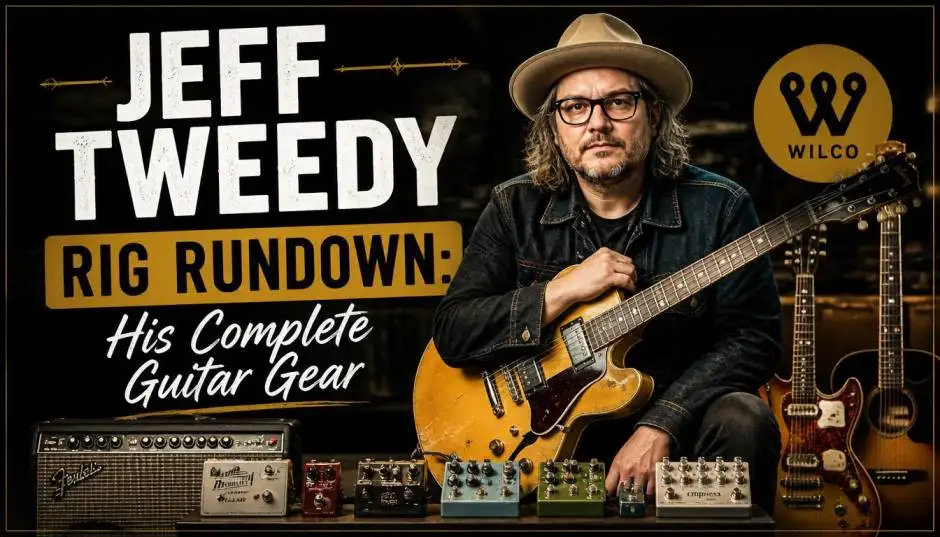
Jeff Tweedy doesn't baby his guitars. The Wilco frontman has spent decades building one of the most interesting collections in indie rock. And he actually plays them.
That's the first thing you notice in any Jeff Tweedy Rig Rundown. He's not a collector who keeps things behind glass. His instruments get used, dinged, and loved. Cut Worms' Max Clarke learned this firsthand when Tweedy produced his album.
Clarke reached for an acoustic guitar in the control room. Tweedy casually mentioned it was the most expensive guitar in the building. The Jeff Tweedy guitar collection spans vintage Fenders, oddball Japanese imports, and signature models. Here's what actually matters from his rig.
The Fender Jazzmaster: His Workhorse
Tweedy bought his first Jazzmaster at a Chicago pawn shop for around $500 . Those days are long gone. Vintage Jazzmasters now sell for thousands.
Read Also: Classic Rock Guitar Signal Chain: Pedal Order Explained
He uses this guitar for Wilco's heavier, lower-tuned material. Songs like "Dawned On Me" rely on its deeper voice. The Mastery bridge upgrade keeps tuning stable even with bass strings installed.
Why does this matter for your own playing? The Jazzmaster's offset body and rhythm circuit give you tonal options most guitars don't offer. The neck pickup sounds warm and jazzy. The bridge pickup cuts through with jangly bite. It's versatile in ways a Strat or Tele can't match.
The Pawn Shop Jaguar
Tweedy grabbed this one when Jaguars were still cheap. He guesses it's a 1964 model . It's been heavily modified.
The original pickups are gone. Now it runs only on a Seymour Duncan Antiquity bridge humbucker. That single-pickup setup keeps things simple. One sound, dialed in perfectly.
This approach works for players who know what they want. Instead of fiddling with switches mid-show, you get one great tone. Tweedy uses this guitar when he needs that specific snarl.
The Greco SG Copy
Here's where Tweedy shows his practical side. Gibson handed him a $20,000 SG to play onstage. He didn't like it. His reasoning makes sense. He wanted to model instruments his fans could actually afford. So he started bringing out a Greco SG copy from the early '80s. It features PAF-style Maxon Dry Z pickups.
You Must Also Like: How to Change Guitar Strings on an Electric Guitar?
The lesson here is simple. Great tone doesn't require vintage prices. Japanese copies from the '70s and '80s often match or exceed the originals. Players in the know hunt these down for exactly this reason.
The Kawai MoonSault Oddity
Tweedy has a soft spot for weird guitars. The Kawai MoonSault proves it. This Japan-made instrument from the 1980s has a scorching-hot preamp wired into it .
Ric Ocasek from The Cars played one too. That tells you something about the guitar's character. It's not subtle. The MoonSault delivers aggressive tones that cut through any mix.
Tweedy owns six or seven of these oddities . He strings this one with flatwounds. That combination creates a sound you won't find anywhere else.
The Top-Loader Telecaster
Fender didn't make many Telecasters with top-loaded strings. Tweedy owns one . He bought it at RetroFret Vintage Guitars in New York.
This Tele lives in open-G tuning. That makes it perfect for Stones-style riffing or slide work. The top-loader bridge changes the string tension. You get a slinkier feel and slightly different resonance compared to a standard Tele.
He loves how it snarls through his Fender Deluxe amp . That combination of guitar and amp creates a sound that's raw and immediate.
The Martin Acoustics
Tweedy's acoustic work deserves attention too. Martin built him a signature model: the 00-DB Jeff Tweedy . It features a deep body and Tweedy Burst finish.
Martin also released the 000-JrE Jeff Tweedy. This compact acoustic pairs a 000 Junior body with a full 24.9" scale length . FSC-certified sapele and spruce give it a warm voice with clear highs. The Martin E1 electronics make it stage-ready right out of the box.
The forum discussions around Tweedy's Martin models reveal something interesting. Players experiment with different string gauges to find their sound. Some prefer monel strings. Others swear by phosphor bronze . Tweedy himself reportedly likes dead strings.
The Dead String Philosophy
This might be the most Tweedy thing about his rig. He doesn't change strings unless he has to.
In a 2019 Premier Guitar interview, he explained why. Dead strings create a sound somewhere between classical and steel string. They have fewer overtones. That narrower spectrum lets his voice sit better in the mix .
His reasoning is honest. He described his singing voice as "like a frog." He doesn't want pristine guitar sounds competing with it. He prefers instruments that feel and sound "a little downtrodden" .
This philosophy won't work for everyone. But it shows how Tweedy thinks about gear. It serves the song. It serves his voice. Technical perfection matters less than emotional truth.
The Fender Champ Amp
Tweedy credits a tiny five-watt Fender Champ as his muse for Wilco's "Star Wars" album. He called it "the biggest fuzzbox on Earth". The Champ's simple design makes it special.
One volume knob. One 8-inch speaker. A single 6V6 power tube . That's it. When you push a Champ hard, it breaks up beautifully. The distortion sounds warm and musical, not harsh.
That's why legends like Eric Clapton and Joe Walsh used them. Tweedy tapped into that same magic. The Champ proves that bigger isn't always better. A small amp cranked up often sounds more exciting than a stack played quietly.
What You Can Learn?
Tweedy's rig teaches practical lessons. First, play your instruments. Don't hoard them. Guitars are tools, not investments.
Second, affordable alternatives work. The Greco SG copy sounds great onstage. You don't need a $20,000 Gibson.
Third, weird gear inspires creativity. The Kawai MoonSault and top-loader Tele aren't standard choices. That's exactly why they create unique sounds.
Fourth, simplicity wins. The Fender Champ has one knob. The modified Jaguar has one pickup. Less choice means faster decisions and more playing.
Tweedy's Jeff Tweedy guitar strings philosophy might seem strange. But it reflects his overall approach. Gear serves the music. Nothing more.
The Jeff Tweedy Fender Champ isn't a fancy boutique amp. It's a practice amp from the 1950s. Yet it shaped one of Wilco's best albums.
That's the real lesson from this rig rundown. Great tone comes from knowing what you want and using gear that delivers it. Price tags and vintage pedigree matter less than feel and character.
Tweedy built his sound over decades. He knows what works for him. That confidence lets him grab any guitar in his collection and make it sing.